Scientific Research & Clinical Evidence in Regenerative Medicine
Wharton’s Jelly: The Premier Source of Mesenchymal Stromal Cells
The umbilical cord is now recognized as a vital source of mesenchymal stromal cells (MSCs) for clinical excellence. As therapeutic deployment increases, understanding the unique derivation and functional characteristics of Wharton’s Jelly is key to unlocking its regenerative potential
Key Scientific Advantages
- Simple & Pure: One of the simplest human connective tissues, ensuring high-quality cell harvesting.
- Homogeneous Population: Provides a more consistent and uniform cell population compared to other tissue sources.
- High Potency: Garnering global clinical attention for its exceptional regenerative and structural capabilities.
- Ethically Sourced: A non-invasive, painless source that avoids ethical concerns while maintaining therapeutic excellence.
Source: STEM CELLS Translational Medicine 2017;6:1620–1630
Breakthroughs in Cartilage Repair & Joint Regeneration
Damaged cartilage has a limited natural ability to self-repair, often leading to joint degeneration. Our research highlights Wharton’s Jelly-derived MSCs as a revolutionary "seed cell" for tissue engineering. These cells offer a painless, ethical, and highly effective alternative to traditional cartilage harvesting, promoting the growth of new, functional cartilage-like tissue
Key Scientific Advantages
- Superior Differentiation: Naturally expresses pre-chondrocyte markers (Sox-9, Col-2A1) essential for building healthy cartilage.
- High-Density Matrix: Proven to form opaque, glistening, non-scaffold cartilage-like tissue with significantly increased collagen content.
- Low Immunogenicity: High purity and low immune response make these cells exceptionally safe for regenerative applications.
- Non-Invasive Alternative: Eliminates the need for painful cartilage harvesting (donor-site morbidity) associated with older treatment methods.
Source: Osteoarthritis and Cartilage Research Journal
Exceptional Structural Repair for Spine & Joint Pain
With over 300 million people worldwide suffering from osteoarthritis and degenerative disc disease, the need for safe, structural repair is critical. Wharton’s Jelly serves as a specialized biological conduit, specifically designed to cushion, cover, and protect damaged intra-articular joints and spinal discs.
Key Scientific Advantages
- 361 HCT/P Compliant: Fully meets the FDA’s criteria under Section 361 of the PHS Act for safe clinical administration.
- Homologous Utilization: Designed to perform the same vital functions in the recipient as it does in the donor—providing structural support and protection.
- Natural Cushioning: Ideal for the reconstruction and supplementation of damaged native cushions in joints and skeletal bones.
- Minimal Risk: Exempt from high-risk premarket approval requirements by fulfilling all 21 CFR 1271.10(a) safety criteria.
Source: Clinical Analysis of Wharton’s Jelly & PHS Act Compliance
MSC-Derived Exosomes for Wound Healing
Exosomes represent a breakthrough in regenerative therapy, offering a powerful "off-the-shelf" solution for skin injuries and chronic wounds. By promoting the migration of dermal fibroblasts and enhancing angiogenesis, these nanovesicles provide a high-stability, cell-free approach to tissue repair in both normal and diabetic organisms.
Key Scientific Advantages
- Enhanced Skin Regeneration: Accelerates the proliferation of keratinocytes and fibroblasts to repair complex skin injuries.
- Pro-Angiogenic Effect: Significantly boosts the angiogenesis process, essential for restoring blood flow to damaged tissues.
- "Off-the-Shelf" Readiness: Standardized isolation protocols allow for immediate intervention in urgent cases like burns and chronic wounds.
- Stability & Delivery: Offers superior storage constancy and body stability, with the unique potential for targeted drug and gene delivery.
Source: MSC’s derived EXOSOMES for Wound Healing
Repair and Regeneration of Skin Injury With Wharton’s Jelly
Traditional treatments for deep skin injuries often result in unsatisfactory scarring and loss of function. This research explores an innovative strategy using hUC-MSCs and Wharton’s jelly to not only repair wounds but to fully regenerate the skin's complex structure, including its vital appendages.
Key Scientific Advantages
- Full-Thickness Restoration: Proven effective in treating full-thickness excisional skin wounds through advanced cell transplantation.
- Regeneration of Appendages: Remarkable development of newly generated hair follicles, sebaceous glands, and sweat glands.
- Multilayered Epidermis: Clearly demonstrates the formation of new epidermis layers, restoring both appearance and function.
- Superior Quality of Repair: A promising strategy that significantly increases the quality of regeneration compared to traditional healing methods.
Source: Repair and Regeneration of Skin Injury With Wharton’s Jelly and MSCs From the Human Umbilical Cord
Exosomes: The Core of Stem Cell Paracrine Signaling
Recent evidence indicates that the therapeutic benefits of stem cells are largely mediated by paracrine factors. By harnessing these exosomes—specialized vesicles originating from multivesicular bodies (MVBs)—we can deliver the regenerative power of stem cells while maintaining a high safety profile and reducing clinical complexity
Key Scientific Advantages
- Advanced Cell Communication: Exosomes play a vital role in cell-to-cell communication, triggering positive regenerative effects across various tissue types.
- Paracrine-Mediated Healing: Utilizes the secretome of stem and progenitor cells to achieve therapeutic results without the use of replicating cell populations.
- Superior Safety Profile: Provides an alternative strategy to harness stem cell potential without the risks associated with pluripotent cell replication.
- Targeted Tissue Regeneration: Functions as a precise delivery mechanism for regenerative factors, offering a sophisticated way to develop new strategies for curing diseases.
Source: EXOSOMES and their therapeutic potentials of STEM CELLS
Umbilical Cord MSCs for COVID-19 & Respiratory Support
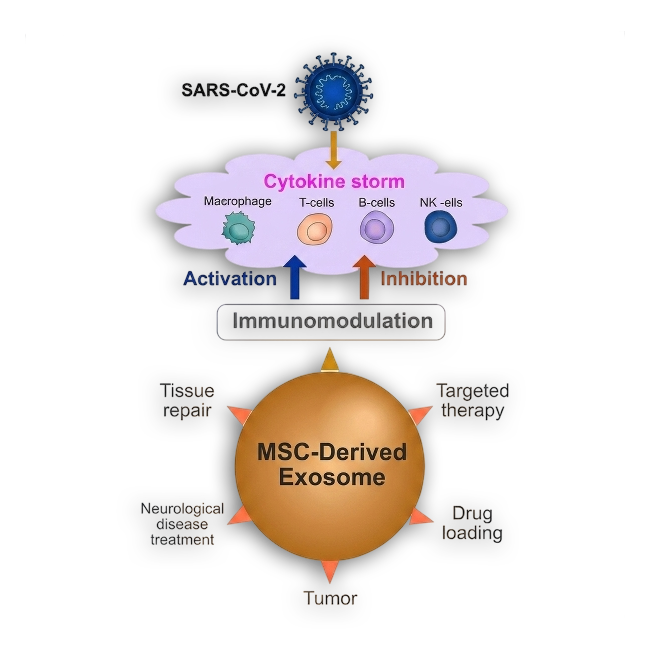
SARS-CoV-2 infection can lead to detrimental levels of pro-inflammatory cytokines, causing acute respiratory distress syndrome (ARDS) and systemic organ damage. Mesenchymal stem cells (MSCs) from the umbilical cord offer a viable, safe, and effective option to modulate the immune response and repair damaged lung tissue.
Key Scientific Advantages
- Immunomodulatory Effects: Proven to reduce symptoms associated with SARS-CoV-2 by managing cytokine and chemokine levels.
- Alveolar Regeneration: Acts as a regenerative technique for alveolar damage, helping to eliminate fluid buildup in the lungs.
- Superior Source (WJ): Wharton’s Jelly-derived MSCs are positioned as the best source due to being rich in regenerative factors and readily available.
- Allogenic Advantage: Unlike autologous sources with limitations, umbilical cord tissue is easily obtainable for immediate, safe, and effective clinical use.
Source: Umbilical cord – for potential treatment of COVID-19